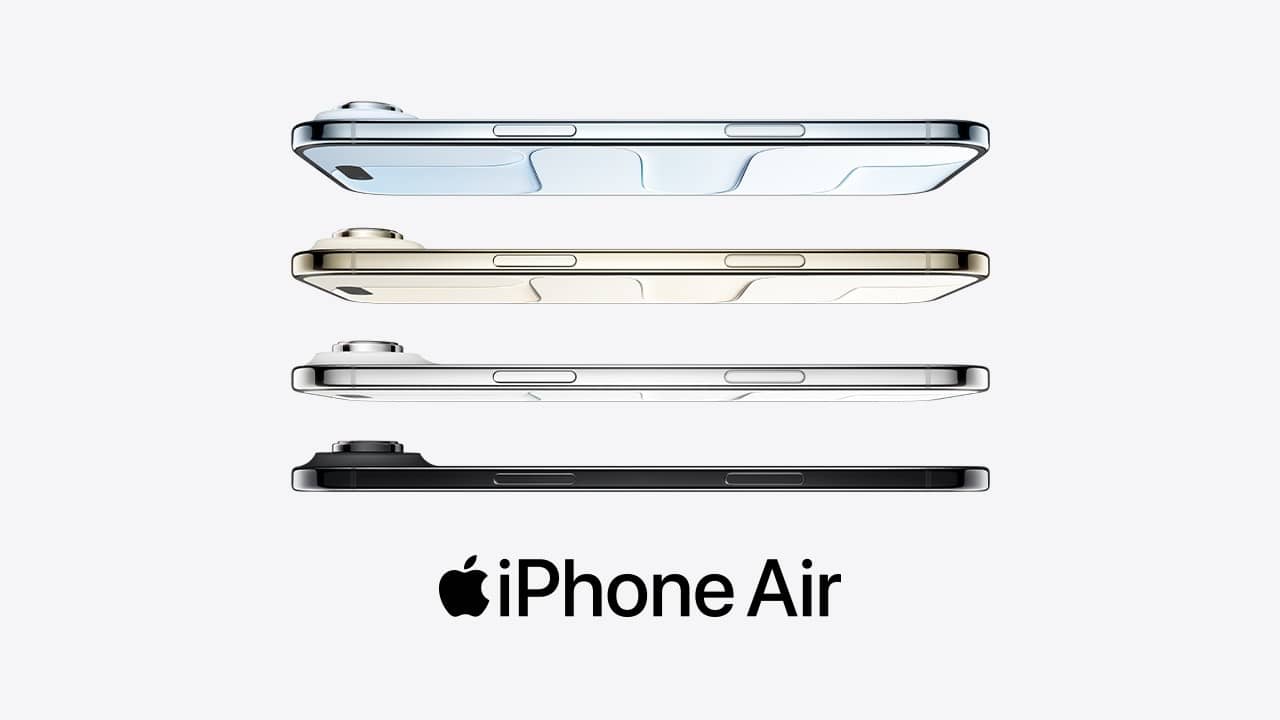
iPhone Air · 2025
iPhone Air: the thinnest iPhone asks what a feature list is worth
iPhone Air review. Apple's 5.6 mm titanium phone is the finest hardware in the line-up and the shortest spec sheet, and the price never quite forgives it.


Excellent
Editorial score out of 10
A phone this thin is an argument, and the iPhone Air makes it before the screen comes on. At 5.6 mm and 165 g it is the lightest iPhone Apple has built, and the first in years whose reason for existing is a shape rather than an item on a list. Everything else follows from that decision: one rear camera instead of three, one speaker instead of two, a USB-C port that charges quickly and moves data slowly, and a battery Apple felt the need to sell an accessory for on the same day.
- 8.1
- Editorial score
- #22
- Of 37 devices reviewed
- 2025
- Released
- 9.6
- Best at: Design
Whether the engineering impresses is not in question. It plainly does, and the reception agreed on that much without hesitation. What splits the published verdicts is the arithmetic afterwards. Reviewers who put the feel of the thing first came away recommending it warmly; reviewers who added up what is missing against what it costs did not, and one of the sharper summaries of the year had it paying more for less. Both readings are defensible, because the Air is the rare product whose compromise is not hidden in a footnote. It is the product.
What it is
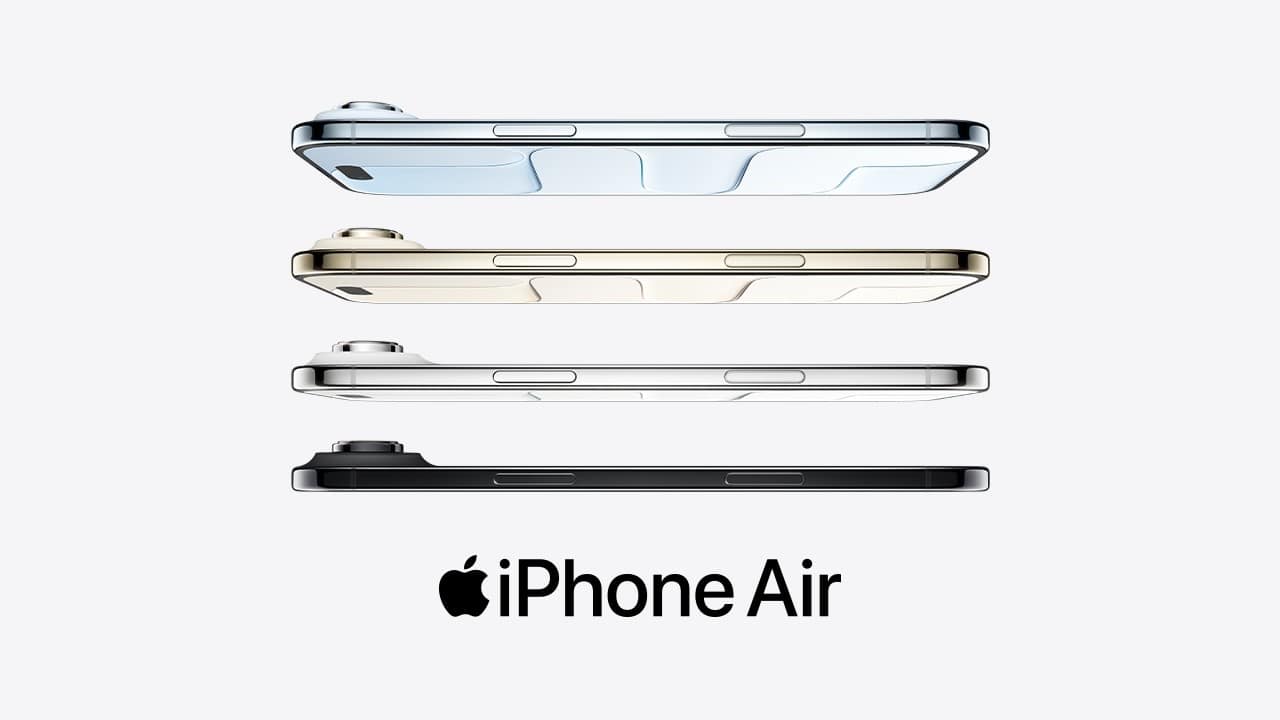
The shape is the result of one structural idea. A raised plateau runs across the top of the back, and inside it Apple has gathered the camera, the speaker, the Face ID hardware and the logic board. That frees the remaining four-fifths of the body to be almost entirely battery, which is how a 5.6 mm phone claims up to 27 hours of video playback at all. The frame is grade 5 titanium with a mirror finish, the front is Ceramic Shield 2, and for the first time the back is Ceramic Shield as well, which is why Apple can call its thinnest phone its most durable without obvious embarrassment.
In the line-up it took the place of the Plus model, and in price it landed between the two phones it will always be set against: $999, with $799 for the iPhone 17 and $1,099 for the iPhone 17 Pro, each at 256 GB. The screen is a 6.5-inch Super Retina XDR panel with ProMotion and an always-on mode, brighter outdoors than any iPhone before it. The chip is the A19 Pro, joined by two of Apple's own radios, the C1X modem and the N1 wireless part. There is no SIM tray, in any country.
9 September 2025
Announced at Apple Park alongside the iPhone 17 and iPhone 17 Pro
12 September 2025
Pre-orders open, at $999 and £999 for 256 GB
19 September 2025
On sale in the first countries; 22 more follow on 26 September
September 2026
The US starting price rises to $1,099, with no change to the hardware
That last line matters more than it sounds, and so does the missing SIM tray. Dual eSIM is a convenience where carriers have caught up and a hard stop where they have not, and this is the first iPhone sold everywhere without the fallback of a physical card. Anyone travelling on local prepaid plans should check before ordering.

Design and build
Picking it up is where the Air does its work, and the reception was close to unanimous about that. A 6.5-inch phone weighing 165 g sits in the hand like a much smaller one, and the titanium edges are rounded just enough that the thinness never becomes a blade. The mirror finish shows fingerprints, and the plateau makes the phone rock on a desk; both are the price of the layout. Set beside an iPhone from five or six years ago, it reads less like a revision than a different category of object.
Durability was the open question and the early answer was reassuring. Published bend and scratch testing found the titanium spine far stiffer than the proportions suggest, and the Ceramic Shield 2 front held up better than the glass it replaced. The usual caveat applies: thin phones live harder lives in pockets, and the plateau is a raised edge that meets the ground first. Apple's IP68 rating covers six metres for half an hour, the same figure the Pro models carry.
The plateau is not a camera bump. It is the whole phone, moved to one end.
Put a case on it and much of the argument goes quiet, which is the honest tension in buying one. The bare body is the feature; a 2 mm shell undoes a good share of what the engineering achieved. Anyone who goes bare, and who has wanted a flagship that does not announce itself through a trouser pocket, is exactly who this was drawn for.
Performance
On paper the Air carries the same A19 Pro as the iPhone 17 Pro. In practice it is a trimmed version of that chip: five graphics cores rather than six, and no vapour chamber behind them. For the things phones are actually asked to do, the distinction never surfaces. Launching apps, editing photographs, scrolling a 120 Hz panel, holding a long video call, running the camera in difficult light — the phone behaves like a current flagship, because it is one.
The distinction surfaces under sustained load, and reviewers reported it consistently. Long gaming sessions and extended 4K recording are the two tasks that put more heat into a thin body than it can shed, and the Air eases off sooner than the Pro does. Accounts differ on how much. Nobody calls it slow; several call it the wrong phone for a demanding game, and that is the fair way to put it. The C1X modem is the quiet win nobody advertises: Apple claims twice the throughput of the C1 at 30% less energy than the modem in the iPhone 16 Pro.
How it measures up
- Portability
- 10/10
- 5.6 mm and 165 g; nothing else in the line is close
- Sustained performance
- 7/10
- Fast in bursts, reported to ease off under long load
- Camera range
- 5/10
- One focal length and a crop, against three lenses on the Pro
- Battery margin
- 7/10
- A day on Apple's figures, with an accessory sold to extend it
- Value at the asking price
- 6/10
- Pro money, after the 2026 rise, for a shorter sheet
Battery is where expectation and reality part company most often. Apple's 27 hours of video playback is a real figure and is not a day of heavy use; reviewers broadly landed on a full day with little in reserve, and on busy days with a charger in sight by evening. The £99 MagSafe Battery exists precisely to cover that, and the fact that it was announced on stage alongside the phone is itself a kind of admission.
What it gives up
One camera, then. The 48-megapixel Fusion main sensor is the same class of part that does most of the work on the Pro models, and the results published alongside the reviews are excellent: sharp, sensibly colour-managed, strong in low light, and flexible enough to give 26 mm, a 35 mm crop and an optical-quality 2x at 52 mm from a single lens. What it cannot do is go wider or longer. No ultrawide means no macro photography and no spatial photos, and the 2x is a crop rather than a lens, so anything genuinely distant becomes a digital zoom problem.
The front camera is the opposite story and got less credit than it deserved. An 18-megapixel square sensor with Center Stage takes a landscape frame without the phone being turned, which sounds trivial and changes how a group photograph actually gets taken. The other subtractions are plainer. The speaker is a single earpiece, so music and video are mono. The USB-C port moves data at 480 Mbit/s and will not drive a display. These are the details nobody checks before buying and everybody notices afterwards.
| Spec | iPhone Air | iPhone 17 Pro |
|---|---|---|
| Thickness and weight | 5.6 mm, 165 g | 8.75 mm, 206 g |
| Rear cameras | One 48 MP, plus a 2x crop | Three 48 MP, to 4x optical |
| Speakers | Mono | Stereo |
| USB-C data | 480 Mbit/s | 10 Gbit/s |
| Display | 6.5 in, 2736 × 1260 | 6.3 in, 2622 × 1206 |
Read that as a statement of intent rather than a scoreboard. Apple did not build a cheaper Pro; it built a different proposition at a price next door to one, and the only useful question is which column describes the reader's week more accurately.
Value and alternatives
At $999 and £999 the Air was a defensible premium over the iPhone 17 for anyone to whom the shape mattered. In September 2026 Apple raised the American starting price to $1,099 without touching the hardware, which puts a one-camera, mono-speaker phone at the figure the three-camera iPhone 17 Pro launched at a year earlier. That is a much harder sell, and it is the single biggest reason this entry does not score higher. The alternatives are both already in the catalogue: the Pro for anyone who wants reach and stereo sound, and the heavier iPhone 16 Pro Max for anyone who treats endurance as the first specification rather than the fourth.
None of that makes the Air a bad phone. It makes it a specific one, and the people it suits will suit it completely, which is more than the rest of the line can claim.
For you if
- Anyone who has wanted a flagship that vanishes in a pocket more than one with three lenses
- Photographers who live at one focal length and rarely reach for an ultrawide
- People already carrying a power bank, for whom the MagSafe Battery is one more magnet rather than a new habit
Not for you if
- Anyone whose phone is their only camera and who shoots wide, macro or long
- Heavy gamers, and anyone recording long video on a warm day
- Buyers counting features per pound, where the iPhone 17 is the better arithmetic
For readers still weighing it against its sibling, our review of the Pro goes further into what the extra 41 g actually buys, and the specification sheet below settles most of the rest.
The head-to-head is where this decision usually gets made.
Head to head

- Value
- 7.08.2
- Design
- 9.67.9
- Features
- 7.28.9
- Performance
- 8.49.3
iPhone 17 Pro edges it by 0.6. See them side by side
Both phones share a chip and a year. They do not share a priority, and that is the whole of it: one is built so that nothing is missing, the other so that nothing is in the way.
What works
- At 5.6 mm and 165 g, a flagship phone that disappears in a pocket
- One 48 MP lens covering 26 mm, a 35 mm crop and an optical-quality 2x
- Titanium frame with Ceramic Shield on both faces and an IP68 rating
- An 18 MP square front sensor shoots landscape selfies without turning the phone
What doesn’t
- One rear lens means no ultrawide, no macro and no spatial photos
- A mono earpiece speaker where the rest of the iPhone line is stereo
- USB-C data capped at 480 Mbit/s, and a US price now $100 above launch
The verdict
The Air is the most accomplished industrial design Apple has put into a phone in a decade, and the engineering that made 5.6 mm possible is new rather than a thinner version of something old. The main camera is excellent, the front camera is better than anyone expected, and the titanium body has survived the scrutiny that met it. What holds the score down is the bill. One lens, one speaker, a slow port and a battery with no margin are real subtractions, and a price that has since climbed to what a three-camera Pro launched at makes them harder to forgive. Buy it for what it feels like in the hand, which is a good enough reason on its own. Do not buy it expecting the rest of the specification to catch up later.


