Rashomon · 1950
Rashomon: four witnesses, one forest, and no version anybody can trust
Rashomon review. Akira Kurosawa's 1950 drama of a killing told by four witnesses is still the sharpest film about memory and self-interest.


Essential
Editorial score out of 10
Rashomon is the rare film whose title became a word. Lawyers, historians and sociologists say "the Rashomon effect" when witnesses contradict one another, and many of them have never seen the eighty-eight minutes that gave them the phrase. That is a pity, because Kurosawa's film is less a lesson about relative truth than a thriller about vanity: about the way every person who touches a crime retells it so that they come out of it with their honour intact.
- 9.3
- Editorial score
- #15
- Of 112 movies reviewed
- 1950
- Released
- 88 minutes
- Runtime
The setup is simple and the execution is not. Three men shelter from a storm under a ruined gate. Two of them have just come from a court hearing about a killing in the forest, and they cannot stop talking about what they heard. What follows is a sequence of testimonies, each one a complete and persuasive short film, and each one incompatible with the last. Seventy-five years on, the shape still feels modern, and the craft still looks expensive.
The premise
Heian-era Kyoto is falling apart. Rain hammers the Rashōmon, the great southern gate of the city, now half collapsed and used as a shelter by anyone with nowhere better to go. A woodcutter, played by Takashi Shimura, and a priest, played by Minoru Chiaki, sit stunned on the steps. A commoner, Kichijiro Ueda, runs in out of the rain, tears planks off the gate to make a fire, and asks them what is wrong. The woodcutter says he does not understand, and the priest says he has lost his faith in people. Then they tell him.
Days earlier, the woodcutter found the body of a samurai in the woods. The bandit Tajōmaru, played by Toshiro Mifune, has been caught, and he admits to the killing. He also admits to raping the samurai's wife, Masako, played by Machiko Kyō. That much nobody disputes. Everything else is contested: how the fight began, who wanted it, how the samurai died, and what the wife did. Each witness in the courtyard speaks directly to the camera, which takes the place of the unseen magistrate, and so the audience becomes the court.
The film handles its central crimes with restraint. The assault happens off screen, implied by a single forced embrace, and the killing is staged as a struggle rather than as spectacle. The weight falls on what the characters say afterwards.
Direction
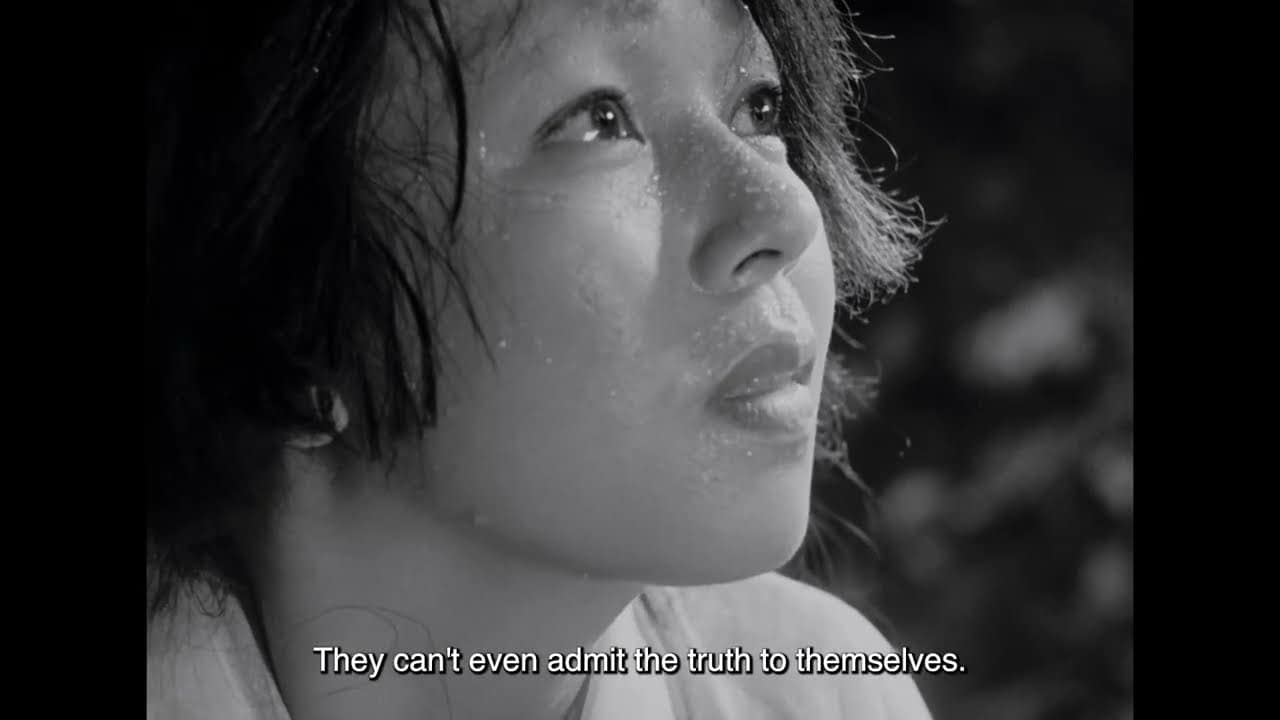
The structure would be a gimmick in weaker hands. Kurosawa's solution is to give each version its own grammar. The bandit's account is all movement: tracking shots through the trees, sudden cuts, a duel shot like an adventure picture, because that is how Tajōmaru sees himself. The wife's account is slower, closer and more static, built on her face and her stillness. The dead samurai's account, delivered through a medium who whirls and moans in the courtyard dust, is something else again: eerie, cold and full of wounded pride.
The courtyard scenes are the hinge. Kurosawa places each witness in the foreground facing the lens, with the other characters sitting in the background, small and impassive, like figures in a painting. Nobody questions them on camera; we hear only their answers to questions we have to infer. It is an austere device, and it makes every testimony a performance staged for us, with all the self-interest that implies. The film never tells the viewer which witness to believe, and it is careful to give each one a motive.
Every account is a confession and an alibi at once.
That double movement is the engine of the whole film. Tajōmaru wants to have been a great swordsman and an irresistible lover. The samurai wants a death that preserves his dignity. The wife wants to be seen as a victim of both men and of her own position. Kurosawa trusts the audience to notice that none of these wishes is entirely false, and that the truth, whatever it was, would satisfy nobody.
Performances
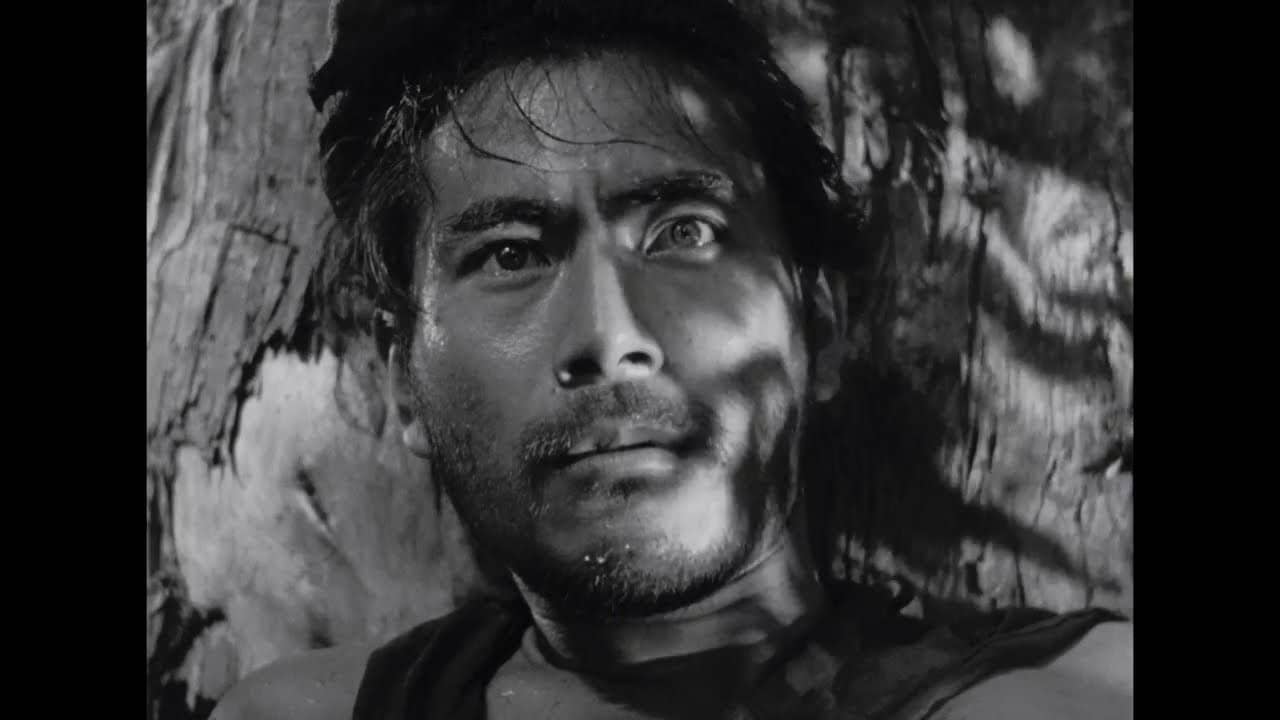
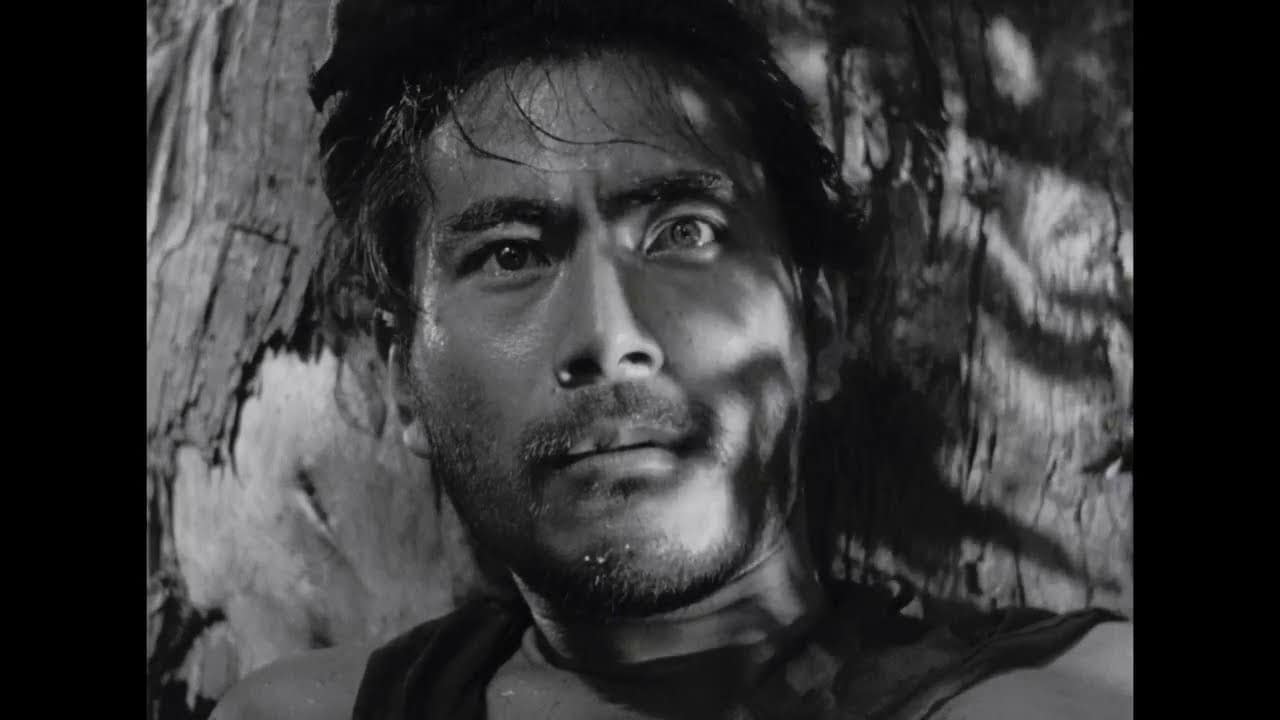
Toshiro Mifune was thirty when the film was made, and Tajōmaru is the role that announced him to the world. He sprawls, scratches, swats at flies and laughs in great barking whoops. It is a deliberately animal performance, closer to silent-film acting than to anything naturalistic, and it has divided viewers ever since. Seen in context, it is a portrait of a man performing his own legend in front of a court. Seen cold, it can feel like a lot of shouting.
Machiko Kyō has the harder job. Masako changes shape in every account, from modest wife to wild avenger to someone colder, and Kyō has to make each version plausible without letting any of them settle into the real woman. Masayuki Mori, mostly bound and silent, does remarkable work with his eyes. Takashi Shimura, two years away from playing the dying clerk in Ikiru, gives the woodcutter a nervous decency that holds the gate scenes together.
| Witness | Played by | How the testimony reaches us |
|---|---|---|
| Tajōmaru, the bandit | Toshiro Mifune | In person, before the court |
| Masako, the wife | Machiko Kyō | In person, before the court |
| Takehiro, the samurai | Masayuki Mori | Through a medium, played by Fumiko Honma |
| The woodcutter | Takashi Shimura | In person, as the man who found the body |
Light and sound
Kazuo Miyagawa's cinematography is the reason the film looks the way it does, and it was radical for 1950. He shot directly into the sun through the forest canopy, so that the light flickers across faces and the leaves become a moving pattern of black and white. Mirrors were used to bounce sunlight into the woods. At the gate, the rain was tinted with ink so that it would read on black-and-white film, and the downpour has a weight that still looks physical rather than staged.
Fumio Hayasaka's score is restrained until it suddenly is not. The music for the wife's testimony borrows the slow, insistent build of Ravel's Boléro, which sounds like a strange choice on paper and works in the film because it makes her account feel trance-like and inevitable. Elsewhere, the score leaves room for the cicadas, the wind in the trees and the endless rain, and the sound design does as much as the dialogue to separate the forest from the city.
How it measures up
- Pace
- 8/10
- Eighty-eight minutes, and every scene earns its place
- Ambiguity
- 9/10
- The film refuses a single answer and means it
- Visual invention
- 10/10
- Sunlight, rain and shadow do the storytelling
- Accessibility
- 7/10
- Stylised acting and a slow opening ask for patience
Where it sits
Rashomon came before the films most viewers know Kurosawa for, and it was the one that opened the door. Daiei had little faith in it at home, and it reached the Venice Film Festival almost by chance. The Golden Lion it won there in 1951, and the honorary Academy Award that followed, turned Japanese cinema from a curiosity into a presence in Western cinemas, and paved the way for everything Kurosawa made in the decade after.
1915
Ryūnosuke Akutagawa publishes "Rashōmon", the story that lends the film its gate
1922
Akutagawa publishes "In a Grove", the source of the testimonies
1950
Rashomon premieres in Tokyo on 25 August
1951
The film wins the Golden Lion at the Venice Film Festival
1952
It receives an honorary Academy Award for the outstanding foreign-language film shown in the US in 1951
1964
Martin Ritt remakes it as a western, The Outrage
2023
The BFI returns a 4K restoration to UK cinemas
Its closest companion in the catalogue is Kurosawa's own epic four years later. The two films could hardly differ more in scale: one a short chamber piece with a cast of fewer than ten, the other a three-and-a-half-hour battle film. They share Mifune and Shimura, the fascination with honour and its hypocrisies, and a director who stages weather as an actor. Watch Rashomon first and Seven Samurai reads as the work of someone who had already proved he could do anything with a camera.
Head to head

- Craft
- 9.69.6
- Story
- 9.29.4
- Direction
- 9.79.9
- Performances
- 9.09.5
Seven Samurai edges it by 0.3. See them side by side
The other useful comparison is more recent. Courtroom dramas built around a contested death, such as Anatomy of a Fall, owe a visible debt to the structure Kurosawa found here, and watching the two together shows how little the basic problem of testimony has changed.
For you if
- Anyone who wants to see where the idea of unreliable witnesses on screen begins
- Viewers curious about Kurosawa but daunted by the length of his epics
- Fans of black-and-white photography that treats light as a character
Not for you if
- Anyone who needs a film to settle what really happened
- Viewers who find stylised, stage-like acting hard to sit through
- Anyone for whom a story built around sexual violence is not one to watch
For those who come away wanting the bigger canvas, the next step is obvious.
What works
- Each testimony is staged as a different film, not just a different set of facts
- Kazuo Miyagawa points the camera straight at the sun and makes the forest glitter
- Eighty-eight minutes, with not one scene that does not turn the argument
- The gate scenes give the audience a jury to argue with, not just a puzzle
What doesn’t
- Mifune plays Tajōmaru at full volume, and the howling laughter can grate
- The wife exists mostly in men's descriptions, and the film only half notices
- The framing dialogue spells out the theme more than the forest scenes need
The verdict
Rashomon earns its reputation not because it invented the unreliable narrator but because it made unreliability visible: every account looks, moves and sounds like the person telling it. The direction and the photography are close to faultless, and at eighty-eight minutes it is the most efficient film Kurosawa ever made. It stops short of the top tier for reasons that are real rather than pedantic. Mifune's broad performance will lose some viewers, the gate scenes underline a theme the forest has already made plain, and the film's interest in the wife is mostly an interest in what the men say about her. Those limits belong to 1950. The central idea, that people lie most fluently about themselves, has not dated at all.


