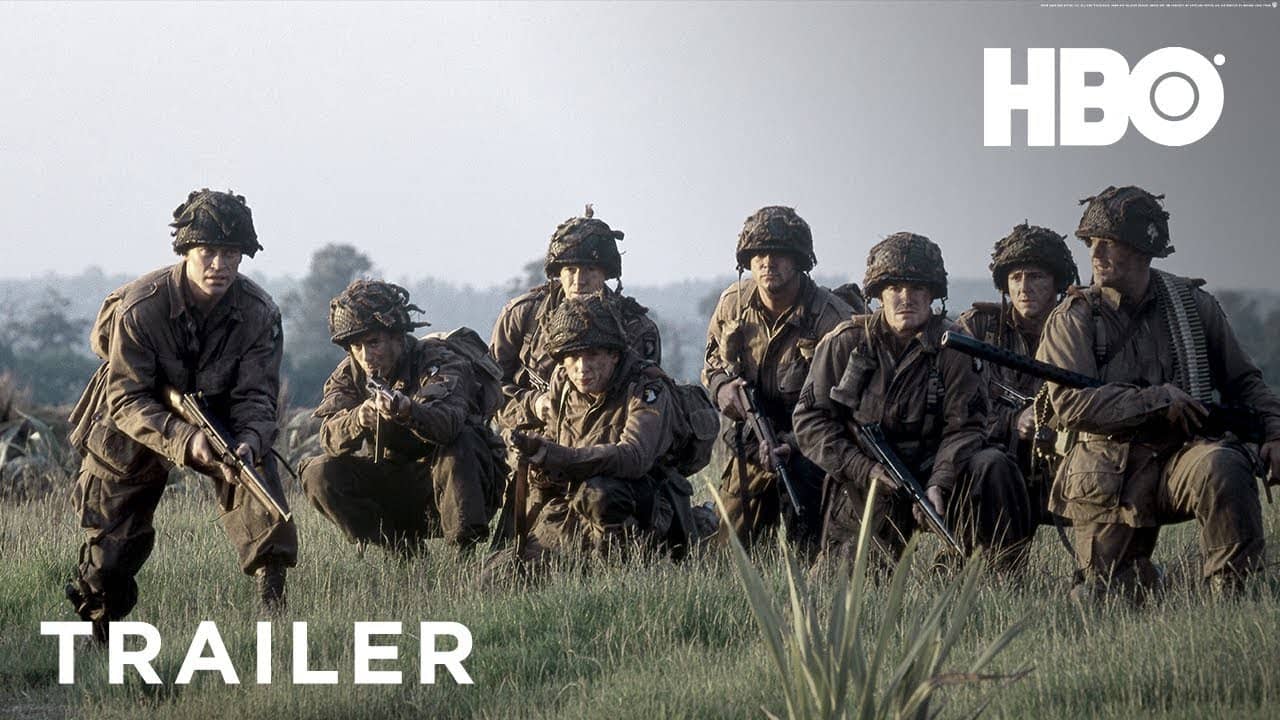
Band of Brothers · 2001
Band of Brothers: the war series that trusts a company of men over a single hero
Band of Brothers review. HBO's ten-part account of Easy Company is still the benchmark for war on television, a few crowded episodes aside.

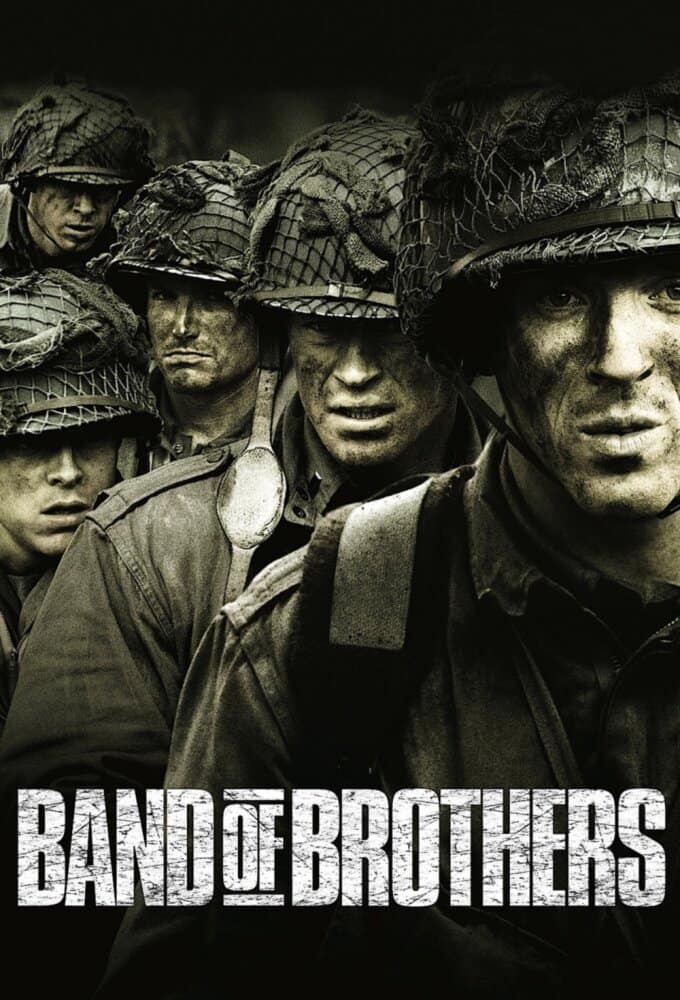
Essential
Editorial score out of 10
Twenty-five years on, Band of Brothers is still the series other war dramas get measured against, and the reason is less its scale than its discipline. HBO and the BBC spent a reported $125 million on ten hours of television, and almost none of that money is spent on spectacle for its own sake. It goes on mud, on weather, on the weight of a parachutist's kit, and on a cast of dozens who are asked to play ordinary men doing a job rather than heroes waiting for a speech.
- 9.4
- Editorial score
- #5
- Of 109 series reviewed
- 2001
- Released
- 10
- Episodes
Tom Hanks and Steven Spielberg came to it straight from Saving Private Ryan, and the series is in many ways that film's correction. Where the film follows a fictional squad on an invented mission, the series follows a real company of paratroopers, named and documented, through a year of campaigning. It refuses the single protagonist that most war stories lean on. The result is slower to start and harder to follow than a film, and far more cumulative: by the halfway mark, the company itself has become the character you care about.
The premise
The series opens in 1942 at Camp Toccoa, Georgia, where Easy Company of the 506th Parachute Infantry Regiment is trained by Lieutenant Herbert Sobel, a commanding officer whose obsession with petty discipline makes the men loathe him and, without meaning to, bind together. David Schwimmer plays Sobel with a brittleness that stops him becoming a cartoon, and the first episode is careful to show that his rigour produces a fit, hardened unit even as it reveals that he cannot read a map in the field.
The second episode is the drop into Normandy on the night before D-Day, and it is the hour most viewers remember. Paratroopers land scattered across the countryside, far from their objectives and from each other, and the episode follows Winters as he gathers whoever he can find and leads them against a German gun battery. It is the moment the series shows its method: no music swelling under the action, no slow motion, just a small group of frightened, highly trained men working out a problem under fire.
The war on this show is a job, done badly and well by people who would rather be anywhere else.
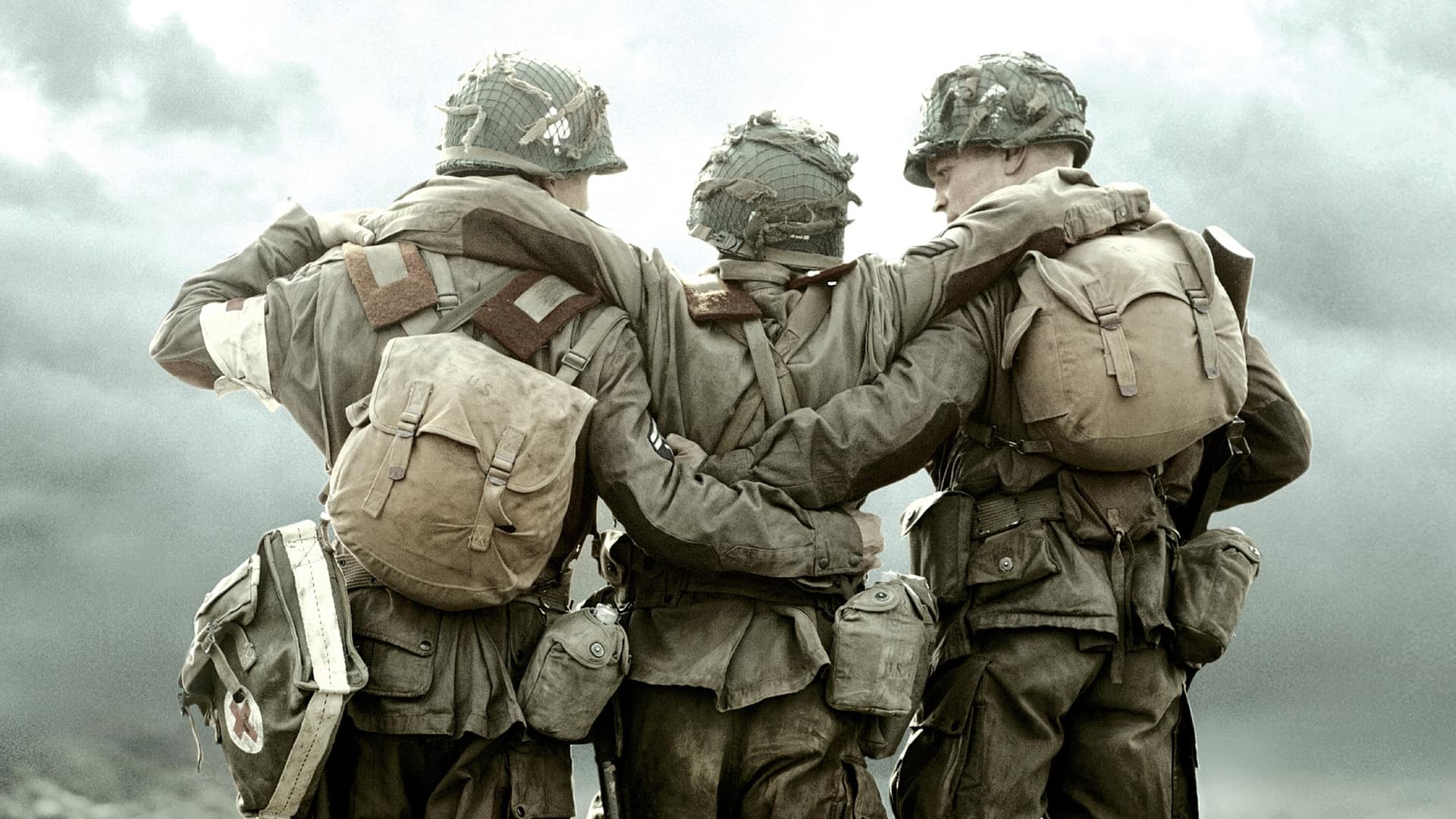
From there, each episode moves the company forward and moves the camera to a different shoulder. A private struggling with fear in the hedgerows, a sergeant among the replacements, a medic, a first sergeant, a writer with a college education, an intelligence officer who prefers whisky to briefings. The structure is the show's boldest decision, and it pays off because the writers keep returning to the same faces from new angles.
Structure, episode by episode
The ten episodes run in campaign order, with directors changing from hour to hour while the look and tone stay remarkably consistent. Tony To, the series' producer, and Tom Hanks each direct one episode; Mikael Salomon and David Frankel direct two apiece. The table below gives the setting and the point of view of each hour without saying what happens to anyone.
| Episode | Setting | Point of view |
|---|---|---|
| 1. Currahee | Training in Georgia and England | Winters and the company under Sobel |
| 2. Day of Days | Normandy, June 1944 | Winters on the night of the drop |
| 3. Carentan | Normandy | Albert Blithe, a private who freezes |
| 4. Replacements | The Netherlands | New men and Sergeant Randleman |
| 5. Crossroads | The Netherlands | Winters, now away from the line |
| 6. Bastogne | Belgium, winter | Eugene Roe, the company medic |
| 7. The Breaking Point | Belgium | First Sergeant Carwood Lipton |
| 8. The Last Patrol | France | David Webster, back from hospital |
| 9. Why We Fight | Germany | Lewis Nixon, the battalion's intelligence officer |
| 10. Points | Austria | Winters, at the war's end |
The pattern has a cost. Episodes four and five are the weakest stretch, partly because Operation Market Garden is hard to dramatise from a company's eye level and partly because the series has not yet earned its large cast; viewers who have not memorised the faces will find some scenes hard to follow. Then Bastogne arrives, and the payoff for all that patience is immediate. The two winter episodes are the heart of the show, and they work because by then the names on screen mean something.
Characters and performances
Damian Lewis, an English actor then little known in the United States, plays Winters as a man whose authority comes from never wasting a word. It is a difficult part, because Winters is admirable without being interesting in the conventional dramatic sense: he does not drink, he does not swear, he does not crack. Lewis finds the drama in his attention, in the way he watches a field before he crosses it and the way he listens to a sergeant. Ron Livingston, as his friend Lewis Nixon, gives the series its dry humour and its sense of someone close to the edge.
Donnie Wahlberg as Lipton and Shane Taylor as the medic Roe are the standouts among the enlisted men, Wahlberg for his steadiness and Taylor for a performance that carries an entire episode almost wordlessly. Scott Grimes, Neal McDonough, Matthew Settle and a very young Michael Fassbender and Tom Hardy pass through in smaller roles. The large cast is a strength in aggregate and a weakness in the moment: in helmets and identical uniforms, several soldiers are hard to tell apart until a scene names them, and the series could have done more to help a first-time viewer.
How it watches
- Pace
- 6/10
- Deliberate early, relentless from the sixth episode
- Combat intensity
- 9/10
- Loud, confused and geographically clear
- Cast to keep track of
- 9/10
- The hardest thing for a newcomer
- Historical rigour
- 9/10
- Built on Ambrose's book and the veterans' own accounts
- Comfort
- 2/10
- Not a series to watch with dinner
Craft
The look of Band of Brothers was copied for a decade. Remi Adefarasin and Joel J. Ransom shot it in a desaturated, high-contrast palette that drains the green from Normandy and the colour from Belgian snow, and the handheld camera stays with the men rather than circling them. The production was based at Hatfield Aerodrome in Hertfordshire, where whole village streets were built for the production, and the sets never look like sets. Sound does as much work as image: the snap of rounds passing overhead, the thud of artillery in frozen ground, the silence after.
Michael Kamen's main theme, a slow, elegiac piece for strings and choir, plays over titles and the veterans' interviews rather than over the fighting, which is exactly where it belongs. The interviews themselves are the series' quietest and best decision. Each episode opens with old men remembering, unnamed until the finale, and it is impossible to watch the drama that follows as entertainment pure and simple when the people it depicts have just been speaking to you.
The series is not without blind spots. It is told almost entirely from the American soldier's side. French and Dutch civilians appear mostly as grateful faces or as obstacles, and German soldiers rarely as individuals, with one or two notable exceptions late on. That is a defensible choice for a series about one company's experience, and the closing episodes push against it. It is still a limit, and a reader coming from a more panoramic history of the war should know it.
Where it sits
HBO followed Band of Brothers with The Pacific in 2010 and Apple TV+ with Masters of the Air in 2024, both produced by the same team and both built on the same idea of real units and real records. Neither matches the first series for cohesion. The Pacific is darker and more fragmented; Masters of the Air is glossier and more conventional in how it builds its heroes.
Head to head

- Craft
- 9.78.1
- Story
- 9.27.0
- Characters
- 9.06.4
- Performances
- 9.37.4
Band of Brothers edges it by 2.3. See them side by side
Band of Brothers also set the template for the prestige limited series in general. A self-contained story, a film budget, rotating directors under a strong producing hand: the model behind HBO's later Chernobyl is visible here, two decades earlier, and it has aged far better than most television of its year.
For you if
- Anyone interested in the Second World War who wants drama that respects the record
- Viewers who like an ensemble that grows on them rather than a single lead
- Fans of Saving Private Ryan who wanted it to slow down and stay longer
Not for you if
- Anyone looking for a single clear hero and a tidy arc
- Viewers who struggle with a large cast in identical uniforms
- Those who would rather avoid graphic combat and battlefield injuries
For anyone who has finished it and wants the same producers' later work, the bomber war is the logical next step, though it is a different and less disciplined series.
What works
- Ten episodes that each shift point of view, so the company is the protagonist
- Veterans' interviews open each hour and keep the drama answerable to fact
- Damian Lewis makes quiet competence the most watchable thing on screen
- Combat staged with clear geography: you always know where the line is
What doesn’t
- A cast this large blurs together in helmets, especially in the early episodes
- The American soldier's view leaves civilians and the enemy mostly in outline
- The middle run of episodes repeats the shape of the one before more than once
The verdict
Band of Brothers earns its place near the top of the scale because it solved a problem war films rarely solve: how to make a reader care about a hundred men rather than one. It does it through structure, rotating the point of view episode by episode, and through patience, letting faces and names accumulate until the winter episodes land with real weight. The craft is exceptional and has barely dated. The score stops short of the very top for the reasons a first-time viewer will feel: a cast too large to follow in the early hours, a soft patch in the middle, and a view of the war that rarely looks beyond the American line. Those are real limits, and they are small against what the series achieves.


