
Blankets · 2003
Blankets: a memoir of first love whose drawings say what its words cannot
Blankets review. Craig Thompson's graphic memoir of faith, family and first love is drawn with rare tenderness, even where its length starts to tell.

Excellent
Editorial score out of 10
Few comics capture what it feels like to be seventeen and certain about everything as well as Blankets does. Craig Thompson's memoir is about a boy raised to distrust his own body, his own drawings and most of the world outside his church, who falls in love for the first time and finds that every certainty he was given has to be weighed again. It is a big book, close to six hundred pages, and much of its length goes on moments that other memoirs would skip: a snowball, a phone call, a quilt being spread across a bed.
- 8.6
- Editorial score
- #29
- Of 53 comics reviewed
- 2003
- Released
- 9.4
- Best at: Art
That patience is the book's great strength and its one real weakness. When it works, which is most of the time, Blankets reads less like a story being told than a memory being relived, with the drawing doing the work prose cannot. When it does not, the reader feels the weight of every page. Twenty years after it first appeared, it remains one of the essential American graphic novels of its decade, and one of the gentlest.
The premise
The book opens in Wisconsin, in a farmhouse where two brothers share a bed because there is nowhere else for them to sleep. Craig is the elder, an anxious, gifted boy who draws constantly; Phil is the younger, the one he protects and sometimes torments. Their parents are devout evangelical Christians, and the household runs on rules about what may be watched, read or thought. School offers no refuge, and neither does church, where other boys find the same reasons to pick on him.
"SHARED" is the sugar-coated way of saying we were TRAPPED in the same bed, as we were children and had no say in the matter.
Years later, a teenage Craig goes to a winter Bible camp and falls in with a small group of misfits. Among them is Raina, a girl from Michigan whose family life is more complicated than his own. They talk, they write letters, they run up long phone calls, and eventually he travels north to spend two weeks with her and her family. That visit is the spine of the book. Around it, Thompson threads memories of his childhood with Phil, so that first love and first loss sit on the same page, often in the same panel.
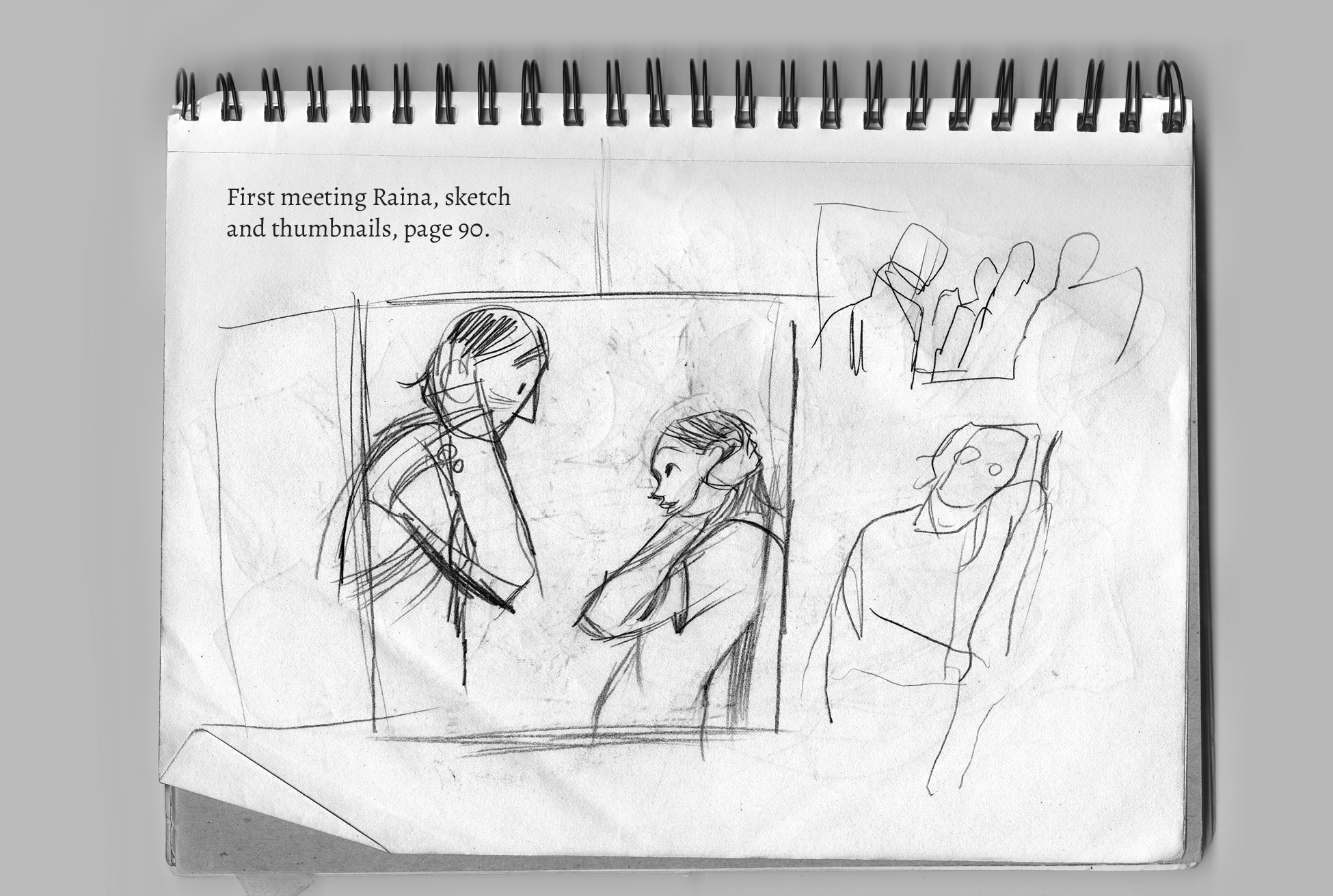
The writing
Thompson writes in a first-person voice that is wry about the boy he was without ever sneering at him. The narration is sparse, and it often stops altogether for pages at a time, leaving the images to speak. Dialogue is plain and convincing: teenagers mumbling, parents issuing instructions, a younger brother who will not stop talking when everyone is supposed to be asleep. The jokes land because they are small and observed rather than built.
The best writing in the book is about faith. Craig's belief is real, and Thompson never treats it as a joke the older narrator is in on. Scripture appears in the text, quoted and argued over, and the boy's guilt about his drawings, his body and his feelings for Raina is rendered from the inside. The book is in large part about leaving the certainties of a strict church behind, but it gets there slowly and honestly, and its respect for what the boy believed is what gives the departure its weight.
1999
Thompson begins work on the book, late in the year
2003
Top Shelf Productions publishes Blankets in July as one volume
2004
Two Eisner, three Harvey and two Ignatz Awards
2006
A challenge in Marshall, Missouri, briefly removes it from the town library
2015
Drawn & Quarterly becomes its publisher, in hardcover and paperback
2023
The 20th anniversary edition adds sketches and other extra material
The art
This is where Blankets earns its reputation. Thompson draws with a brush, in black and white, and his line moves between three registers without warning: a loose, rubbery cartooning for comedy and childhood, a careful realism for rooms and landscapes, and an ornamental, almost liturgical style for dreams, prayers and moments of feeling too large for ordinary panels. The shifts never feel like a stunt. They feel like the way memory actually works, sharpening some moments and turning others into pattern.
Snow is the book's great subject. It falls across whole pages, softens every outline, fills the gaps between panels and stands in for silence. The early pages of the brothers in bed, under a heavy patterned quilt, set the visual rhyme the rest of the book keeps returning to: blankets as shelter, as a hiding place, as something made by hand for someone else. When Craig and Raina walk through a forest at camp, the trees and the snow do almost all the talking, and the reader understands the scene before a word is spoken.
Thompson also designs pages rather than simply filling them. Panels dissolve into each other, figures float free of borders, and some spreads are built like illuminated manuscripts. Not every one of these is necessary, and a few feel decorative for their own sake. But the ambition is part of what made the book matter in 2003, when long-form comics about ordinary life rarely looked this lavish.
Characters
Craig is the most fully realised person in the book, as the subject of a memoir tends to be, and Thompson is unsparing about his self-pity and his tendency to make everything about himself. Phil, the younger brother, is the book's quiet heart: present in nearly every chapter, often in flashback, and the person whose relationship with Craig turns out to matter as much as any romance. The parents are drawn without cruelty. They are strict, sometimes frightening, and still recognisably trying to do right by their sons.
Raina is the problem. She is warm, funny and burdened with responsibilities at home, and the book gives her real scenes of her own, particularly with her family. But she is filtered through a teenage boy's longing, and much of the time the drawing turns her into an image of that longing rather than a person with her own point of view. That is honest to the experience being remembered. It also leaves her the least solid of the main figures, which a reader notices more as the book goes on.
How it reads
- Emotional intensity
- 8/10
- Quiet, then overwhelming in places
- Plot momentum
- 4/10
- Moods and memories over events
- Visual invention
- 9.5/10
- Every chapter tries something new on the page
- Accessibility
- 7/10
- Easy to follow, though the length asks for patience
Pacing and format
Blankets was conceived and published as one book, not a run of issues, and it reads best in long sittings. The chapters move back and forth between the brothers' childhood and the winter Craig meets Raina, and the cross-cutting is handled with real skill: a childhood game echoes a teenage moment, a remembered argument sharpens a present one. The opening third, from the farmhouse to the camp, is close to perfect.
The middle is where the book slows down. Craig's visit to Raina's family stretches over a long run of pages, and while many of them are beautiful, some repeat a mood the reader has already absorbed. Thompson is clearly trying to preserve every moment of something that mattered to him, which is understandable in a memoir and harder to sustain in a story. Readers who love the book tend to love this section most; readers who drift away usually drift here.
| Edition | Publisher | Pages | Worth knowing |
|---|---|---|---|
| Paperback | Drawn & Quarterly | 592 | The standard text, in black and white throughout |
| Hardcover | Drawn & Quarterly | 592 | Same content, bound to last |
| 20th anniversary edition | Drawn & Quarterly, 2023 | 640 | Adds sketches, thumbnails and notes on the making of the book |
| UK edition | Faber & Faber | 592 | The edition sold in British bookshops |
Where to start
The answer is simple: there is only one Blankets, and any current edition gives the full text. The anniversary edition is the one to choose for a reader already sure they will love it, since its extra pages show how Thompson thumbnailed and pencilled the book before inking. A first-time reader loses nothing with the plain paperback.
Its nearest neighbour in the catalogue is Marjane Satrapi's memoir, another account of growing up inside a faith and a family that the author later stepped away from, told in black and white. The two make a revealing pair. Satrapi is political, sharp and economical; Thompson is private, lyrical and expansive. Both believe the drawn page can carry an inner life that a camera could not reach.
Head to head

- Art
- 9.48.4
- Story
- 8.39.1
- Pacing
- 7.98.5
- Characters
- 8.49.2
Persepolis edges it by 0.4. See them side by side
Readers coming from [Maus](/item/maus) will find a very different kind of memoir, smaller in its stakes and softer in its voice, but built on the same faith in drawing as testimony.
For you if
- Readers of graphic memoir who want something tender rather than political
- Anyone who grew up in a strict religious household and remembers the first doubts
- Lovers of black-and-white brushwork and inventive page design
Not for you if
- Readers who want a tightly plotted story; this one moves at the pace of memory
- Anyone looking for a book to hand to a young teenager, given its content
- Readers who need a romance to give both people an equal voice
For anyone new to long-form comics, Blankets is one of the friendliest ways in: no superheroes, no back catalogue, just one book about growing up.
What works
- Brush drawing that turns snow, quilts and blank space into the book's real language
- The brothers' shared childhood bed gives the whole memoir its emotional anchor
- Page designs that slip from realism into scripture and dream without a seam showing
- Treats a teenager's faith seriously instead of mocking the boy who held it
What doesn’t
- Raina is seen almost entirely through Craig's longing and stays partly out of focus
- The long middle visit lingers on moods the book has already made clear
- Some decorative pages are lovely to look at and add little to the story
The verdict
Blankets is one of the books that showed what an American graphic novel about ordinary life could look like, and it still looks extraordinary. Thompson's drawing turns snow, sheets and silence into a vocabulary of feeling, and his account of a boy outgrowing the faith that formed him is fair to everyone involved, including the boy. The score stops short of the top tier for reasons the book itself makes visible: a middle stretch that lingers longer than its story needs, and a first love who remains more an image than a person. Those limits are real, and they are the limits of memory itself. For readers willing to move at its pace, it is a deeply rewarding book, and one that is easy to return to every few winters.


