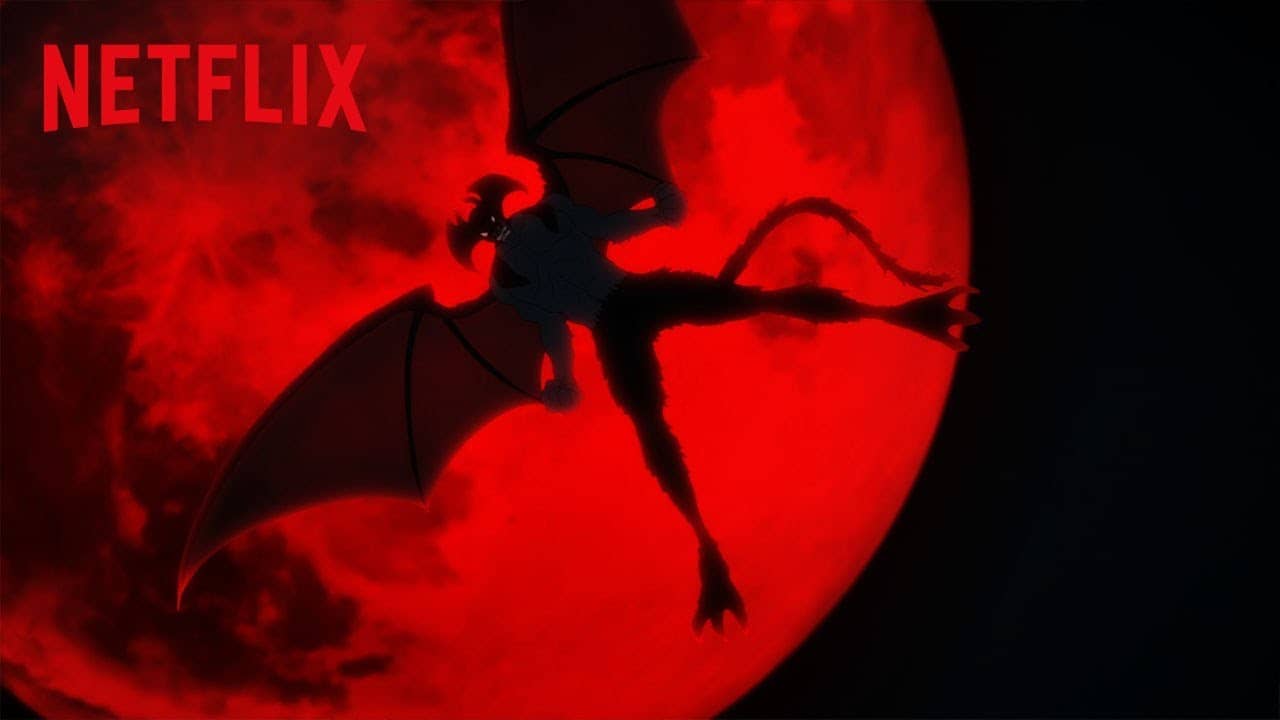
Devilman Crybaby · 2018
Devilman Crybaby: a fifty-year-old manga made raw, loud and newly frightening
Devilman Crybaby review. Masaaki Yuasa turns Go Nagai's 1970s Devilman into ten furious, tender episodes for Netflix that are hard to watch and harder to forget.

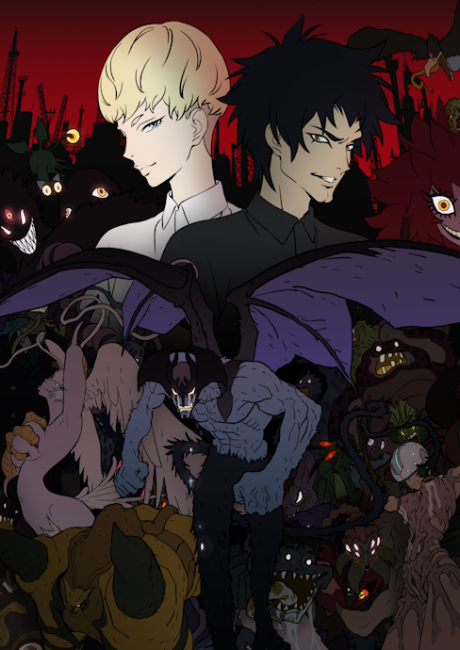
Excellent
Editorial score out of 10
Devilman Crybaby takes a manga from 1972 and makes it feel as though it were written last week by someone very angry and very sad. Masaaki Yuasa keeps the bones of Go Nagai's story, a boy who becomes a demon to fight demons, and rebuilds everything around them: smartphones, livestreams, a high-school track team, rappers on a riverbank, and a soundtrack that sounds like a heartbeat in a nightclub. The result is one of the most talked-about anime Netflix has released, and one of the few that earns the noise.
- 8.6
- Editorial score
- #34
- Of 93 anime reviewed
- 2018
- Released
- 10
- Episodes
It is also not for everyone, and pretending otherwise would be dishonest. The series is explicit about sex and extreme about violence from its first episode, and its tone swings between slapstick, melodrama and horror within a single scene. Yet underneath the excess sits a simple, almost old-fashioned idea: the hero's defining power is that he cries for other people. Everything that follows is a test of whether that is enough.
The premise
Akira Fudo is a sweet, timid boy who lives with the family of his friend Miki Makimura, a star of the school track team, while his parents work abroad. Ryo Asuka, a childhood friend who left for university years ahead of his age, turns up one night carrying a rifle and a theory. Demons, he says, ruled the Earth before people did, and they are waking up inside human bodies. The only way to fight them is to take a demon's power while keeping a human mind, and the only person he trusts to do it is Akira.
The first episode follows that idea into an underground club, a scene that sets the series' terms immediately. What Ryo calls a Sabbath is a party designed to draw demons out through intoxication and abandon, and the possession that follows turns Akira into Devilman: a horned, winged creature with demon strength and appetites, but still Akira inside. From there the opening act settles into a rhythm of school, home and hunt. Akira becomes an athlete whom no one can catch, a boy whose new body wants things his old one never did, and a fighter who weeps after every fight.
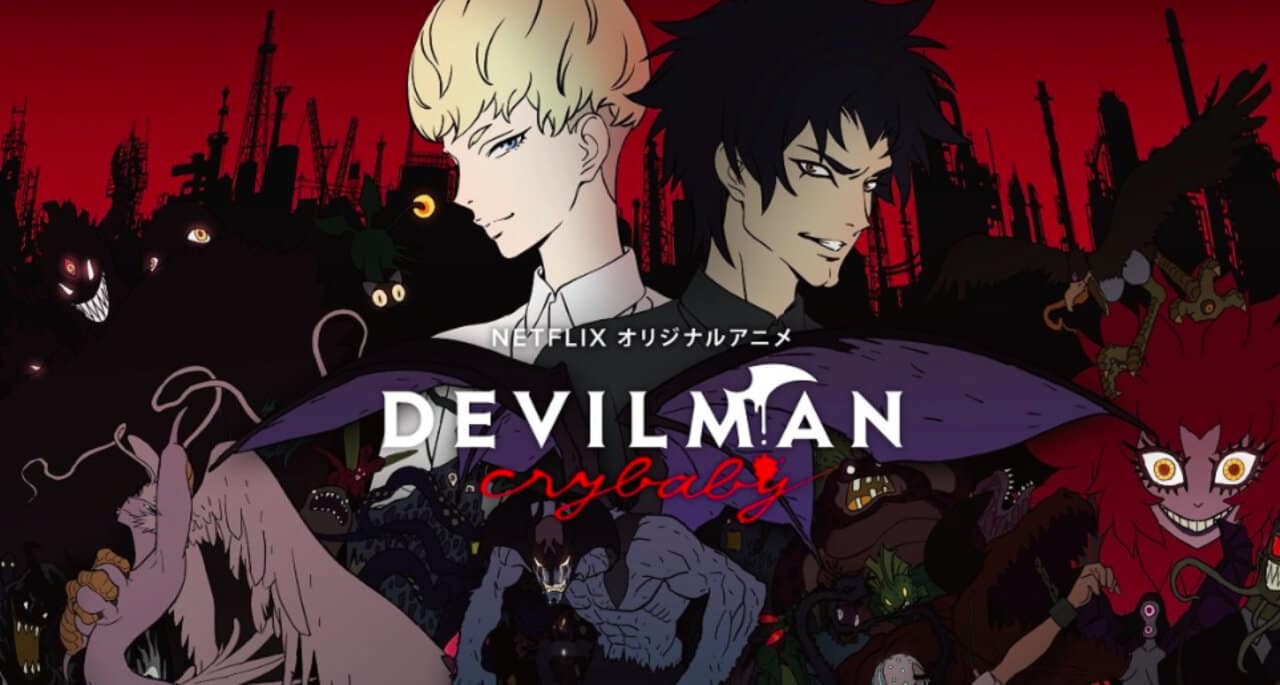
Story and structure
Ichirō Ōkouchi's scripts compress a long manga into ten episodes of roughly twenty-five minutes, and the compression is the point. Early episodes are close and personal: a demon Akira cannot bring himself to hate, a rival sprinter who will not leave him alone, Miki's family dinners, Ryo's cold surveillance of everyone around them. Each episode adds a little more to the world while keeping Akira at the centre, and the opening act works as a story about a teenager whose body is changing faster than he can understand it, told through the grammar of a monster show.
Then the frame widens. Without giving any of it away, the series moves from one boy's secret to a question about what ordinary people do when they are frightened, and the answer it gives is not comforting. The decision to set the story among phones and social feeds is what makes this work for a new audience. Rumours spread in seconds, footage goes viral, and suspicion is crowdsourced. Nagai wrote Devilman as a story about war; Yuasa and Ōkouchi have made it a story about how quickly a community decides who counts as human.
The weakness of the structure is its speed. Some characters arrive, matter enormously for an episode, and are then carried away by the plot before they feel complete. The adaptation also asks viewers to accept large leaps in time and scale between episodes with very little bridging. For many, that momentum is exactly the appeal. For others, the later episodes will feel more like a series of shocks than an argument, and the ending, which divided viewers sharply on release, does nothing to settle the matter.
1972
Go Nagai's Devilman manga begins in Weekly Shōnen Magazine, alongside a gentler television anime
1987
An original video animation adapts the opening of the manga with a harder edge
2017
Netflix and Aniplex announce Devilman Crybaby to mark Nagai's fifty years as a creator
2018
All ten episodes released worldwide on Netflix on 5 January
2019
Named Anime of the Year at the Crunchyroll Anime Awards, with Yuasa winning Best Director
Characters
Akira is the reason the series holds together. A protagonist defined by crying could easily read as a joke, and the show is not above playing it for comedy, but his tears are never treated as weakness. He cries because he sees other people's pain clearly, and his transformation does not cure him of that. In a genre full of heroes who toughen up, a hero who refuses to is a deliberate choice, and it gives every fight a cost.
Ryo is his mirror: brilliant, controlled, unreadable, and so devoted to Akira that devotion starts to look like something else. Their relationship is the emotional spine of the series, and the scripts trust viewers to read what the characters cannot say. Miki is warmer and more capable than the girl next door she first appears to be, and the series gives her a life of her own through the track team and the online world she shares with her friends. Miko, the classmate who envies Miki, gets one of the most affecting episodes in the series, a portrait of jealousy and loneliness that refuses to become a punchline.
The supporting cast is drawn in quick strokes. The street rappers, Wamu among them, start as background colour and become the show's conscience, commenting on events in freestyle verses that land as a Greek chorus with a beat. Ken the 390, who supervised the rap sequences, also voices Wamu in the Japanese version, and the scenes feel lived in rather than borrowed.
Animation
Science Saru's work here does not resemble a polished action series, and it is not trying to. Yuasa's style is elastic: limbs stretch, perspectives tilt, and figures are drawn with thin lines and flat colour that let the movement do the work. The running scenes, with Akira and his rivals pumping their arms in long loping strides, became a fan favourite precisely because they look like nothing else. Kiyotaka Oshiyama's demon designs are grotesque and inventive, and Ayumi Kurashima's character designs keep the humans slight and breakable beside them.
That looseness is both the strength and the cost. In the action scenes it makes violence feel chaotic and frightening, never choreographed into something cool. In quieter passages, especially conversations in mid-shot, the economy sometimes reads as thinness rather than intent. The animation is at its best when emotion and motion arrive together, such as a sprint that turns into grief or a fight that becomes a plea, and those moments are frequent enough to carry the rest.
How it measures up
- Intensity
- 9.5/10
- Graphic from the first episode and harder still later on
- Emotional pull
- 9/10
- Built on Akira's empathy, which the series never mocks
- Pace
- 8.5/10
- Ten episodes with almost no slack, sometimes too little
- Visual polish
- 6.5/10
- Expressive rather than refined; quieter scenes can look thin
- Accessibility
- 4/10
- A demanding first episode and a tone that swings hard
Sound
Kensuke Ushio's score is the element critics and fans praise most consistently, and it is easy to hear why. It is electronic, percussive and restless, built on low pulses and distorted textures that sit somewhere between club music and horror cinema. In the Sabbath sequence it becomes part of the scene's logic; elsewhere it supplies quieter, melancholic cues of real tenderness that gather around Akira. The soundtrack, released by Aniplex as a two-disc set, holds up as listening in its own right.
The songs widen the palette. Denki Groove's "Man Human" opens each episode with a pounding techno loop that matches the series' unease, and a remix of the 1970s theme, "Devilman no Uta", performed by Avu-chan of Queen Bee, turns nostalgia into something stranger. The rap interludes, recorded by working rappers, give the street kids a voice that no script could fake. Taken together, the sound design does a great deal of the emotional explaining that the dialogue chooses not to.
Where to start
No prior knowledge of Devilman is needed. The series stands on its own, and the 1970s television anime is a gentler, very different work. The question is simply whether the opening episode works for you; if it does, the rest follows naturally, and the ten episodes make a short commitment.
Akira's power is not that he becomes a demon. It is that he never stops crying for anyone.
Viewers who know Yuasa from his sports drama will find the same restless drawing and the same faith in physical motion turned to very different ends. The comparison below sets the two side by side.
Head to head

- Sound
- 9.18.9
- Story
- 8.49.1
- Animation
- 8.58.8
- Characters
- 8.69.5
Ping Pong the Animation edges it by 0.5. See them side by side
For those coming to Crybaby from more recent action series, Chainsaw Man shares its scrappy hero and appetite for gore, though Crybaby is the more emotional of the two. Our entry on Chainsaw Man is a natural companion, and so is Parasyte: The Maxim, another story of a teenager sharing his body with something inhuman.
For you if
- Adult viewers who can handle explicit violence and sex in service of a serious story
- Anyone curious about Masaaki Yuasa's directing or Science Saru's restless style
- Fans of horror who want monsters that ask questions about the people around them
Not for you if
- Anyone who wants a polished, conventionally beautiful action series
- Viewers who find graphic sexual content or gore a barrier rather than a context
- Those who prefer stories that end with reassurance
The series is available in full on Netflix in Japanese with subtitles and in several dubs. For a different side of the same director, the review of his sports series is the place to begin.
What works
- Akira's kindness is the engine of the story, so every escalation costs something
- Kensuke Ushio's pulsing electronic score makes dread feel physical
- Rap interludes from the street kids act as a chorus commenting on the action
- Ten episodes with no filler; the whole arc lands in a single weekend
What doesn’t
- Sexual content in the opening episodes is blunt enough to drive viewers away early
- Loose, sketchy drawing in quieter scenes can look rushed rather than chosen
- Several supporting characters get only an episode before the story moves past them
The verdict
Devilman Crybaby is uneven, deliberately excessive, and in places hard to sit through. It is also one of the most emotionally direct anime of its decade, a story that uses demons and gore to ask what kindness is worth when everyone around you is afraid. Yuasa's animation gives up polish for urgency, Ushio's score turns dread into rhythm, and Akira remains a hero worth following because he refuses to harden. The score is held below the top tier by animation that sometimes looks thin, supporting characters who get too little time, and a level of explicit content that will stop some viewers in the first episode. For those who stay, the ten episodes leave a mark that few series of any length manage.


