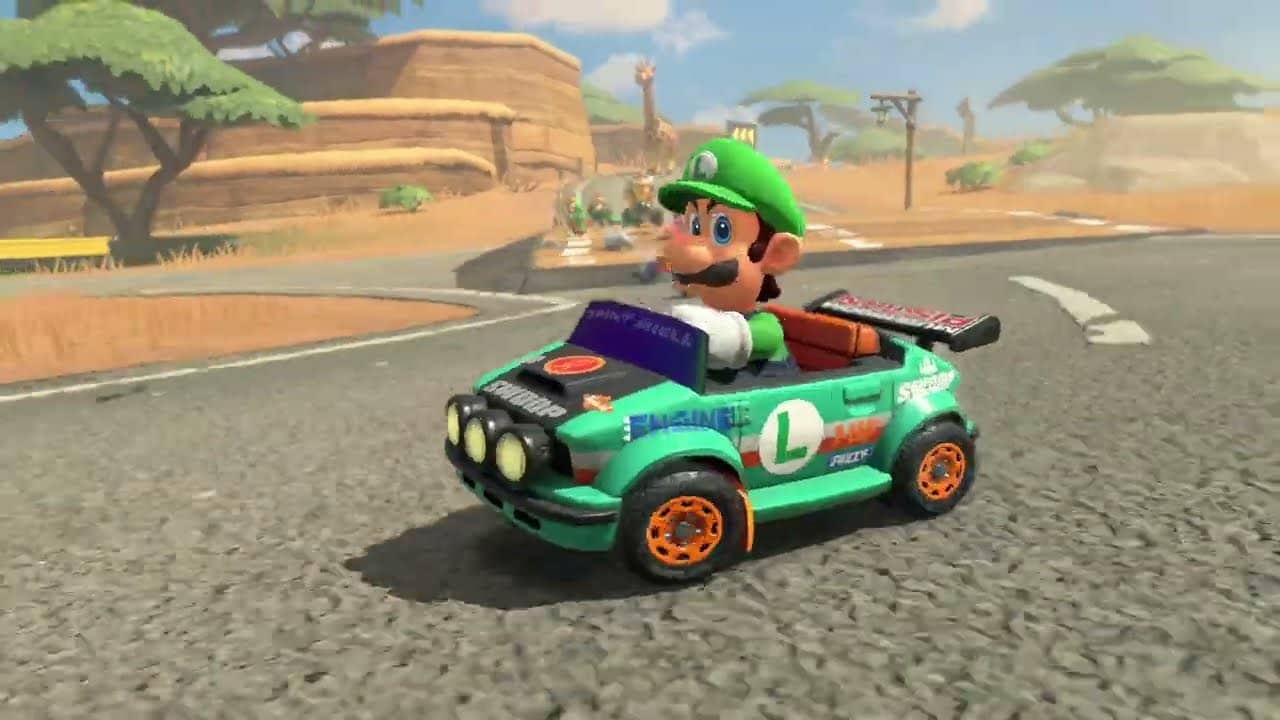
Mario Kart World · 2025
Mario Kart World: the series finally leaves the circuit, and mostly finds its way
Mario Kart World review. Nintendo's Switch 2 launch racer joins every course into one open map, with 24-player races and a superb Knockout Tour mode.


Excellent
Editorial score out of 10
For three decades, Mario Kart has been a game about laps. Learn a circuit, learn its shortcut, take the third lap faster than the first. Mario Kart World keeps that game but sets it inside a single map, so the courses are places on the way to somewhere else and the roads between them are part of the race. It is the boldest change to the series since items stopped being optional, and it lands about three-quarters of the time.
- 8.7
- Editorial score
- #67
- Of 116 games reviewed
- 2025
- Released
- 9.3
- Best at: Presentation
The quarter that misses is easy to name: long connecting roads that are too wide and too straight to be interesting, and a Free Roam mode that has a lot of world and not much to do in it. The rest is the best-handling, most crowded and most generous Mario Kart Nintendo has made, built around a new mode, Knockout Tour, that the series will struggle to do without from now on.
How it drives
The handling is the part Nintendo was least likely to get wrong, and it has not. Drifting still builds a boost, items still decide the final corner, and a player who knows the older games is competitive within minutes. What World adds is a layer of movement on top. Karts can grind along rails and fences, ride briefly along walls, and charge a hop that launches them onto ledges the racing line does not obviously reach. Water no longer slows anyone down for long, because every vehicle becomes a boat when it hits a lake.
These techniques are optional, which is why they work. A newcomer can ignore every rail and still finish mid-pack; an experienced player finds that each course now has a second, higher route running over the first. The effect is closer to a skateboarding game than to a traditional racer, and it gives the familiar items more room to matter: a shell that would have hit a kart on the tarmac sails underneath one grinding on a fence above.
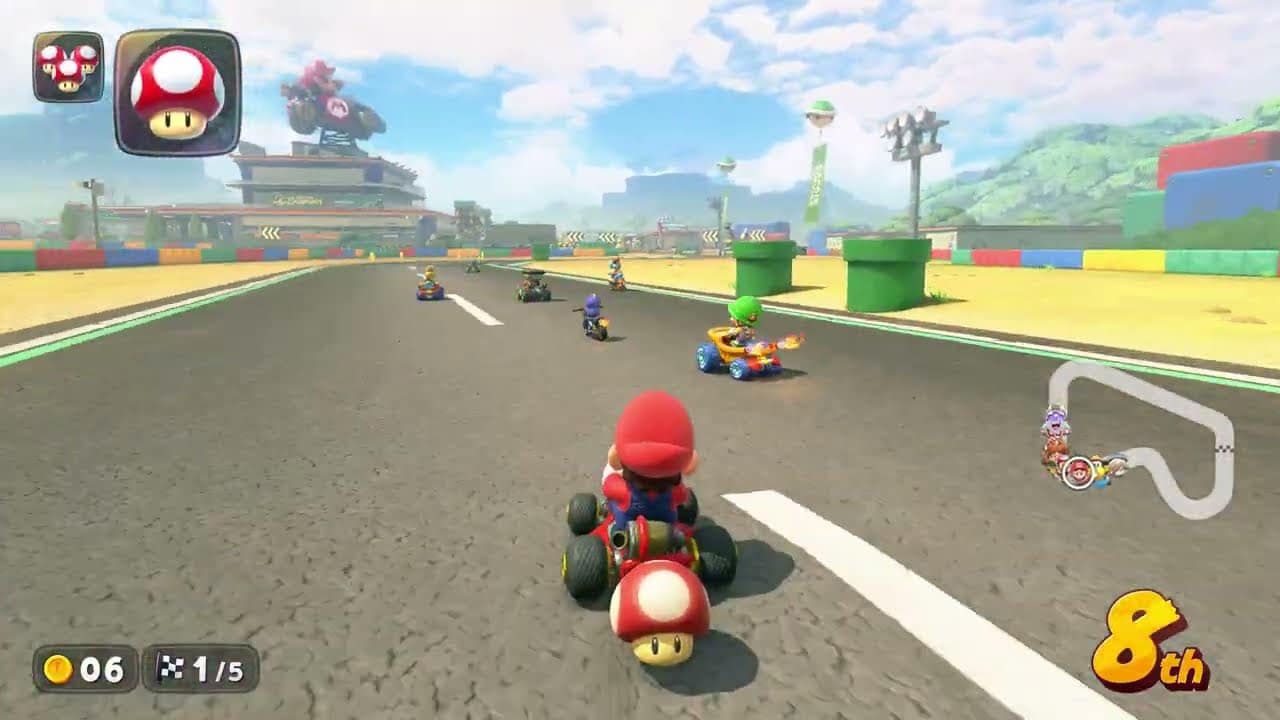
The other big change is the field. Twenty-four racers is double the twelve of Mario Kart 8 Deluxe, and the packs are correspondingly chaotic. Item spam is real in the middle of the grid, yet the game stays legible. Characters are distinct at a glance, the minimap is clear, and the cast includes oddities such as a cow driving a truck, which grew out of the developers turning old course obstacles into racers.
How it measures up
- Ease of entry
- 9/10
- Steering and acceleration assists for first-timers
- Skill ceiling
- 8/10
- Grinds, wall rides and charge jumps reward practice
- Chaos per lap
- 9/10
- Twenty-four racers and a full item table
- Free Roam depth
- 5/10
- A big map with modest things to find in it
The world between the courses
The connected map is the idea the game is named for, and the developers have explained that they dropped the number 9 because it was a different kind of game rather than a larger one. In Grand Prix, only the first race of a cup is three laps of a circuit. The rest begin at the previous course and drive to the next, finishing at the destination. On paper, that turns a cup into a road trip. In practice, the result depends heavily on which road the trip takes.
The good connections run through towns, along coastlines and over cliffs, with traffic to dodge and terrain that changes underfoot. The weaker ones are multi-lane highways with gentle bends and nothing much happening, and they can make up a large share of a race. A fast drift is only interesting when there is a corner to take it round. The problem spilled over into online play after launch, when an update briefly made these connecting courses far more common in the random rotation; Nintendo walked that back in a later patch, but the underlying weakness is in the design rather than the playlist.
Free Roam is the purest expression of the idea and the least developed. The whole map, with the exception of Rainbow Road, is open to drive at leisure, with a day-night cycle, changing weather and a photo mode. Scattered across it are short challenges, coins and collectables in the spirit of the missions from Mario Kart DS. They are brief and pleasant, and few of them build into anything. As a lobby to idle in while friends arrive, it works; as a reason to play on its own, it does not.
The best road in Mario Kart World is the one that is still a race. The worst is the one that has forgotten it is.
Knockout Tour
Knockout Tour is where the open map pays off completely. Twenty-four racers start at one end of a region and drive a single long rally through several of its courses. At each of the checkpoints along the way, the last four drivers are eliminated, until the final stretch is a straight fight between the four who remain. There are no laps and no second chances.
It is the game's best mode by a distance, because it solves the problem the Grand Prix has. The connecting roads stop being filler when every one of them is the gap between staying in and going home. A slow start is recoverable, but only just; a single blue shell at the wrong checkpoint can end a run. Online, with a full field of human players, it has the tension of a battle royale and the rhythm of a rally, and it sends the music on a continuous run from one region's theme to the next.
| Mode | What it is | Best for |
|---|---|---|
| Grand Prix | Cups of four races, linked by roads across the map | Solo progression and unlocks |
| Knockout Tour | One long rally; the last four are cut at each checkpoint | Online play and tension |
| VS Race | Custom races, including classic three-lap circuits | Groups who want the old format |
| Battle | Balloon Battle, Coin Runners and Bob-omb Blast | Short sessions with friends |
| Free Roam | Open driving with missions and collectables | Exploring and photo mode |
Presentation and sound
World is a launch title built to show what the Switch 2 can do, and it looks the part. Courses are dense with detail, the lighting shifts across the day, and the art direction has the rounded, saturated look of recent Mario projects. The new costumes, unlocked by picking up food from roadside stands, are small touches with outsized personality: outfits that often match the region they are found in, so the cast seems to dress for the trip.
The soundtrack, led by Atsuko Asahi with a team of Nintendo composers and outside musicians, is the quiet star. Course themes come with dedicated intros and outros so that a Knockout Tour plays like a medley, and Free Roam draws on a library of more than two hundred arrangements of tunes from across the Mario games, in styles that run from big-band swing to jazz fusion. It is the most musically ambitious game in the series.
The interface is where the polish thins. At launch, several characters and costumes were unlocked in ways the game barely explained, and some menu decisions drew complaints; a September 2025 update made unlocking characters easier, and later patches have smoothed other edges.
Price, launch and updates
The game's history explains several of its shapes. Prototyping started on the original Switch in 2017, but an open world with 24 racers proved too much for that hardware, and in 2020 development moved to the successor. The Booster Course Pass for Mario Kart 8 Deluxe was conceived partly to bridge the gap.
2017
Prototyping begins on the original Switch, just before Mario Kart 8 Deluxe
2020
Development moves to the Switch 2 after hardware limits on 24-racer open-world play
2025
Revealed alongside the Switch 2 in January; launched with the console on 5 June
2025
A September update rebalances online rotations and eases character unlocks
2026
Free updates add Bob-omb Blast, new rallies and courses from Super Mario Kart
The launch price of $79.99 in the US drew criticism, being higher than most standard editions of big-budget releases. The bundle with the Nintendo Switch 2 softened that for anyone buying the console anyway, and a steady run of free updates since launch has added modes, rallies and classic courses without further charge. It is the reason the console exists for many players, and Nintendo has treated it accordingly.
Next to Forza Horizon 5, the obvious open-world racer on another platform, World is far smaller as a place to explore and far stronger as a place to race against other people.
Head to head

- Story
- 6.45.6
- Gameplay
- 9.19.1
- Longevity
- 8.59.0
- Presentation
- 9.39.6
Forza Horizon 5 edges it by 0.1. See them side by side
That split explains most of what follows. For a solo driver who wants a map full of things to collect, Playground Games' approach is deeper. For a living room or an online lobby, nothing else comes close.
For you if
- Anyone with a Switch 2 and friends or family who will pick up a controller
- Online players looking for a racer with real tension in the closing minutes
- Series veterans who want new techniques to master on top of the old ones
Not for you if
- Solo players hoping for an open world to explore at length
- Anyone who thinks Grand Prix should be four circuits and nothing in between
- Buyers who resent premium pricing for a first-party launch game
For Switch 2 owners deciding what to play alongside it, Nintendo's other big release of the console's first summer makes a fine counterpart.
What works
- Knockout Tour turns a whole region into one long, tense elimination race
- Rail grinds, wall rides and charge jumps give skilled drivers new lines to find
- Twenty-four racers make every pack crowded, loud and readable at once
- A soundtrack of reworked Mario themes that changes as the road does
What doesn’t
- Long straight connecting roads blunt the Grand Prix and some online rotations
- Free Roam is pleasant to wander but thin on things worth doing
- A launch price above most standard games, with no cheaper route in
The verdict
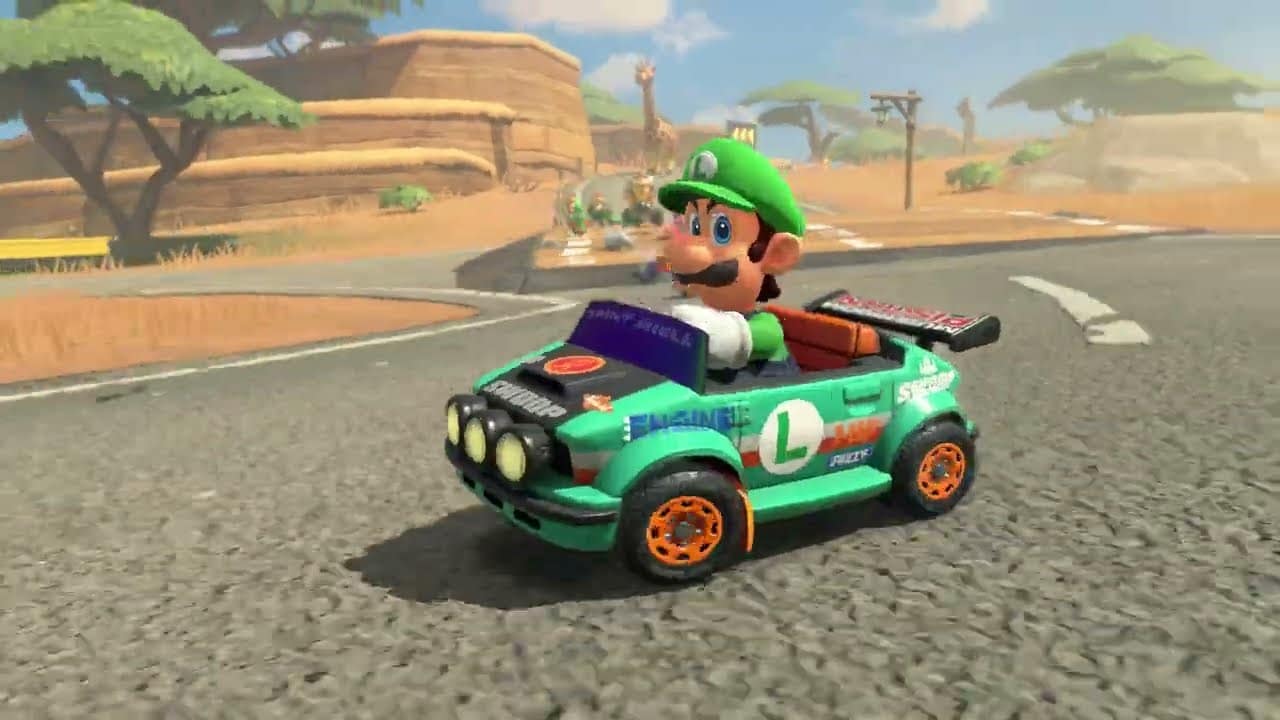
Mario Kart World takes a real risk with a series that could have coasted on another set of circuits, and the risk is worth it. The handling is the best the series has had, the new movement gives every course a second layer, and Knockout Tour is an instant classic of party and online play. The score stays below the top tier for two reasons that come from the same idea: the roads that join the courses are too often empty stretches, and Free Roam opens a world without giving it enough purpose. Story barely exists, as in every Mario Kart, and is scored accordingly. Neither flaw touches the moment-to-moment racing, which is the thing a kart game must get right, and post-launch updates have steadily improved what was already there.


